

Robin Taylor is Associate Head of St Pauls Nursery School and Children’s Centre and a Specialist Leader in Early Mathematics. He is professional development lead for the NCETM’s Early Years Programme in Somerset and facilitates the Maths Network for Bristol and Beyond Stronger Practice Hub. Robin is obsessed with Block Play and is currently working with Bristol University PHD student Michael Rumbelow in researching block play at St Pauls.
Adventures in Block Play – Part 1 by Robin Taylor
In this two-part series, Robin reflects on the ‘language’ of block play- how children’s exploration reveals deep mathematical thinking, and how adults can nurture that understanding through environment, observation and talk.
The “Language” of Block Play
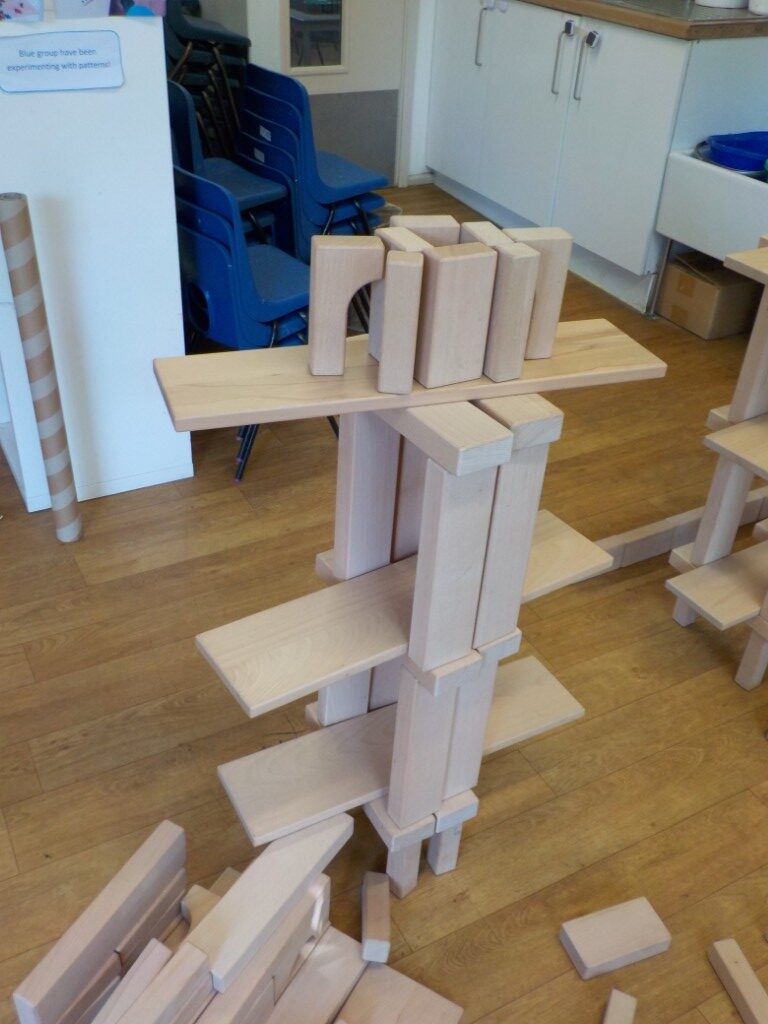
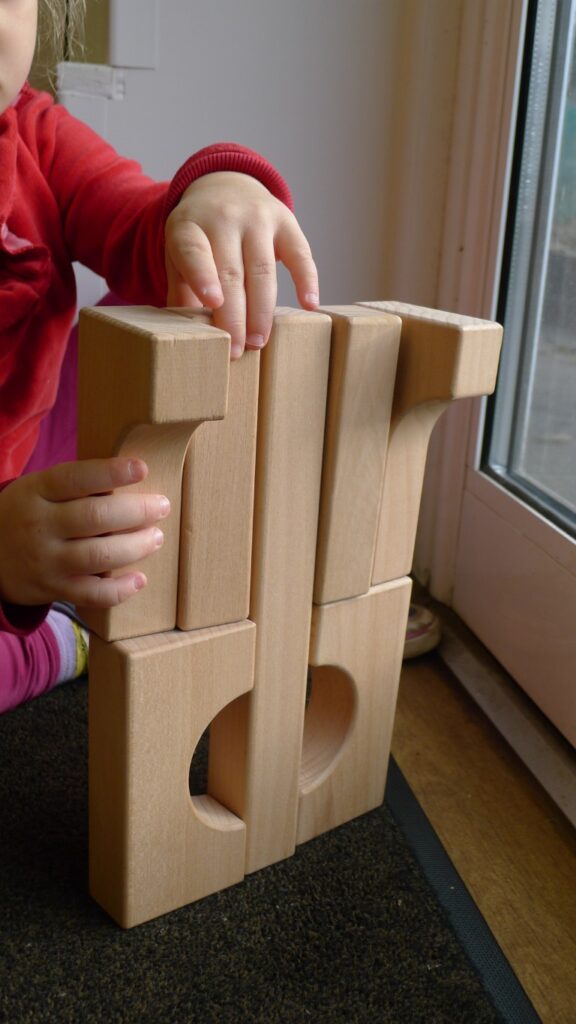

It is said Blocks have a language of their own!
When children hold them, weigh them, mouth them – explore them with all their senses – what do the blocks ‘say’?
There is a language of natural texture, of course.
Of something that looks and feels lovingly made – a beautiful aesthetic carved from wood!
There is a language of weight and dimensions, of a magical mathematical ratio.
The unit block has a ratio of 1:2:4 – it is 14cm long, 7cm wide, and 3.5 cm thick (5.5, 2.75, 1.375 in inches).
The blocks have a language of comparison, of fractions, of part-whole composition.
How many half-blocks are needed to build the same length as a unit, a double unit, a quadlong?
There is a language of pulling-apart and pushing back-together, of composition and decomposition.
How do I place these quarter circles and curves together to make circles?
There is a language of equivalence and transformation.
How many units do I need to change them to a double or a quadlong? What is a quadlong equal to?
There is a language of stacking, of bridging, of enclosing.
How do I stand and balance these units, these cylinders, these pillars to hold up my bridge?
Of course, Block Play is full of all sorts of play, of endless possibilities.
Block Play is not only full of mathematical possibilities, but of scientific, engineering, architectural, and creative possibilities too.
And we know children learn holistically – with Block Play supporting all areas of the Early Years Foundation Stage.
Who can watch children at play with the Blocks and not observe social interaction – collaboration and turn-taking – or communication and language, or physical development, or creative development, or children representing and modelling their knowledge and understanding of the world around them?
And of course, blocks are deeply and intrinsically mathematical.
Block Play Through a “Mathematical Lens”
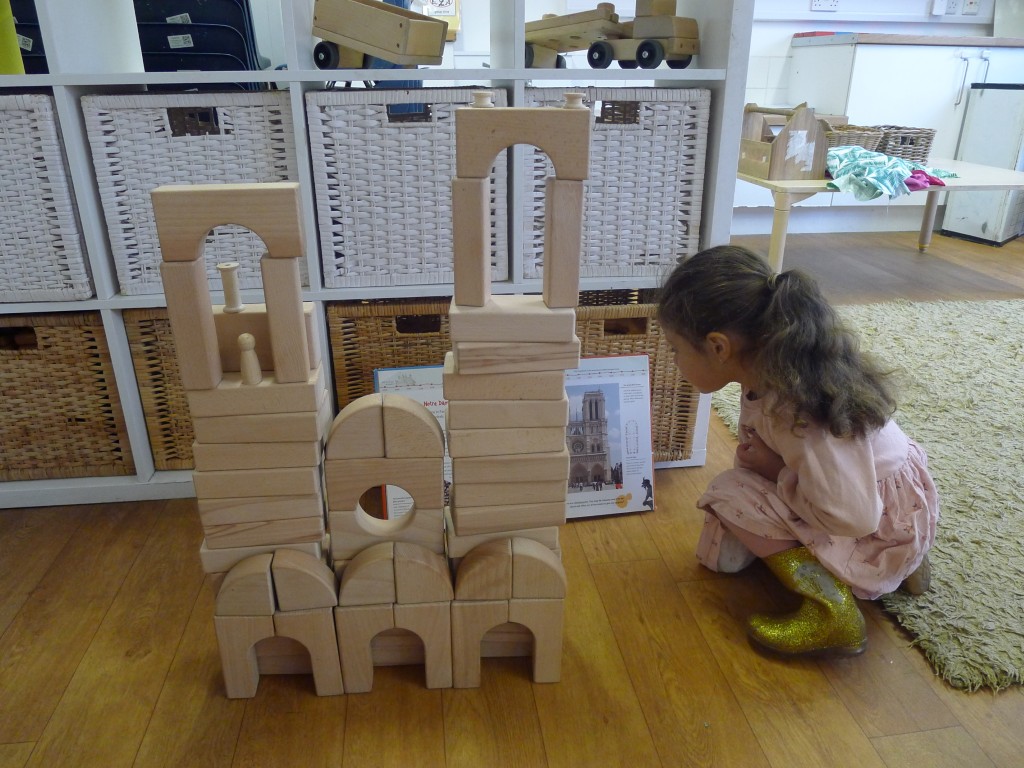
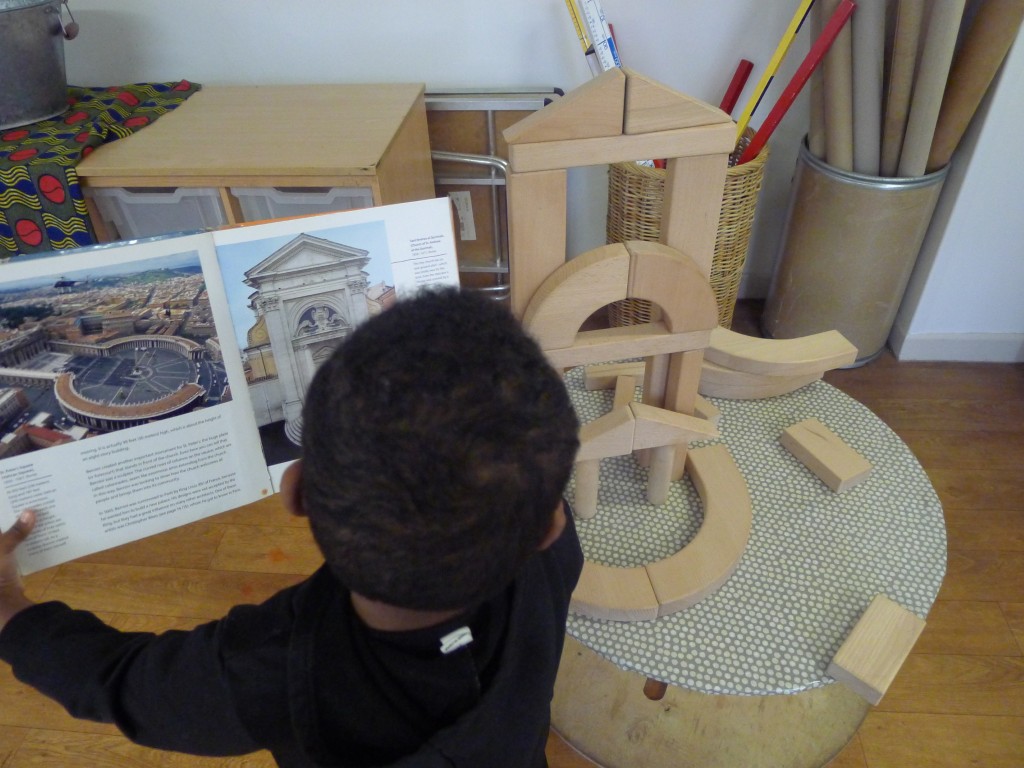
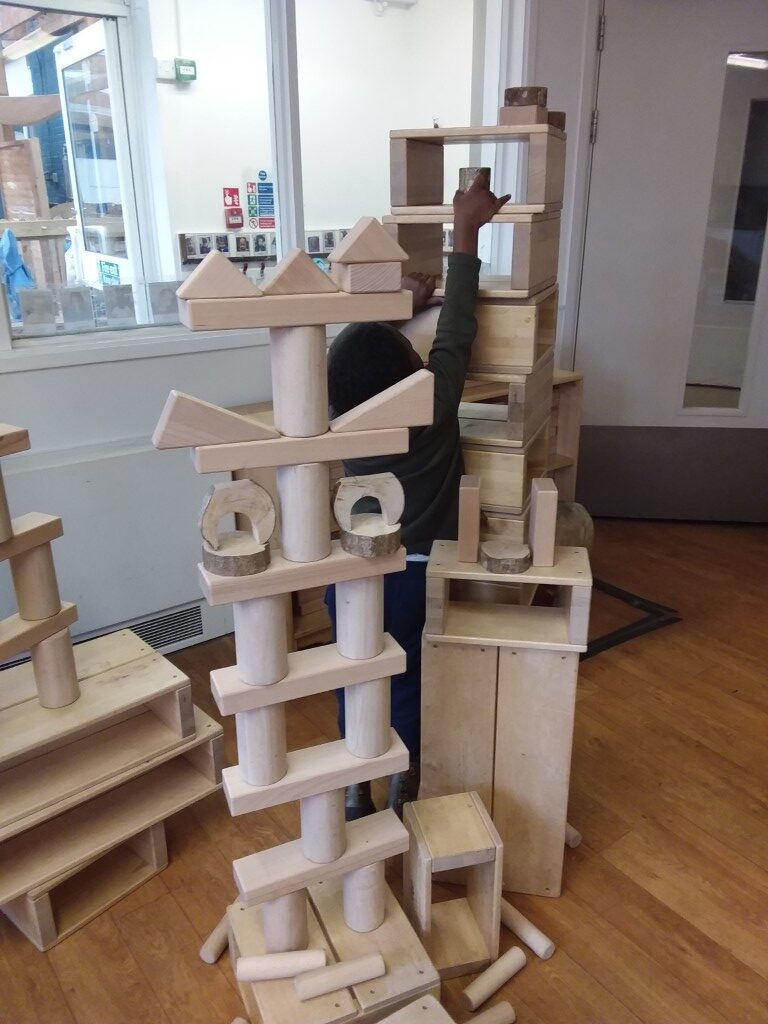
Here at St Pauls Nursery School and Children’s Centre, we have been playing, thinking, researching, and reflecting on the brilliance of Block Play – how it affords children a visual and tangible experience of all sorts of mathematical concepts, knowledge, skills, and understanding.
We have been thinking about the Education Endowment Foundation (EEF) recommendations around developing practitioner understanding of how children learn mathematics, how we dedicate time to early maths, threading it throughout the day, and how we use manipulatives and concrete materials to develop understanding of key mathematical concepts.
This is informed by the EEF approach, teaching and modelling how to make comparisons and connections,
which highlights the value of helping children notice relationships, size, shape, pattern, balance and proportion as they reason and make sense of the world through play.
We have also used the work of the Early Childhood Maths Group Spatial Reasoning Toolkit – their brilliant guidance on all things to do with shape, space and measures!
What is spatial reasoning?
Perhaps for young children, it is the question “does this fit here?” or more importantly, “do I fit in here?”
The ECMG talk about how children develop ‘spatial reasoning’ through recognition, visualisation, and representation.
So, children use all their senses to explore space and shape properties – they begin to recognise these properties and attributes.
Children imagine and manipulate this ‘spatial information’ in their ‘minds’ eye’ as they move themselves and objects in, over, around and through spaces.
Here, children begin to be fluent and confident in visualisation to help them remember, make links and predict problems and solutions – of fitting in, fitting together, taking apart of materials and objects.
Children then begin to represent their ideas, their experiences of the concrete world around them.
Here, they use gestures, language, models, 2D representations, pictures, drawings, maps, graphs, and diagrams.
They say, “Look! I am making sense of my world. I am showing you my thinking… my ideas… my understanding of the solid, tangible, 3D world I am navigating and finding my way around!”
When using the Blocks, children are developing ideas around spatial relations and objects and images, as well as having visual and physical clues to key aspects of counting ( such as subitising, abstraction, hierarchical inclusion and magnitude, amongst many others ). Here at St. Paul’s Nursery School and Children’s Centre, we have used the ECMG’s Spatial Reasoning Toolkit as a “road map” and “guide” to develop our mathematical subject knowledge.
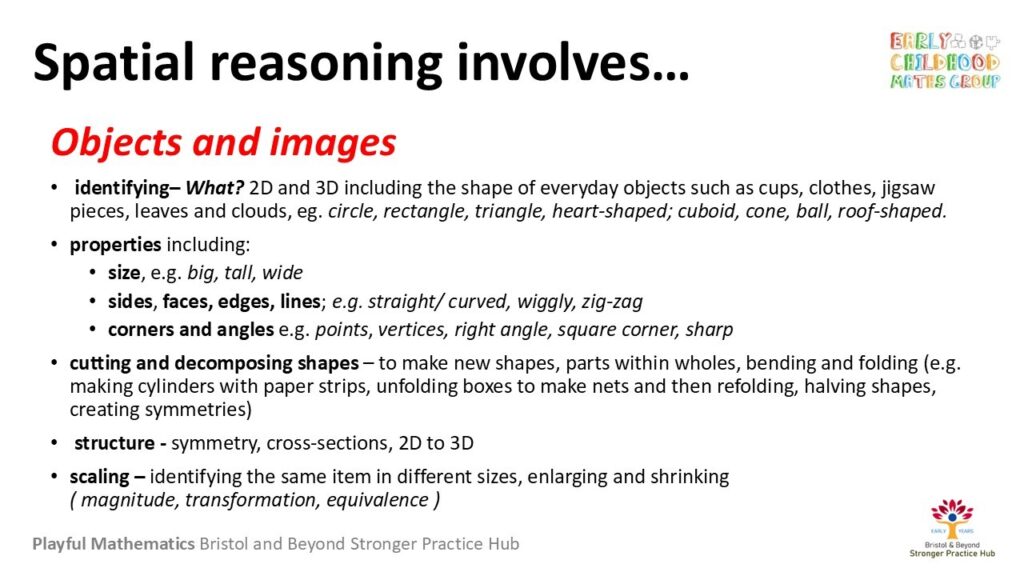
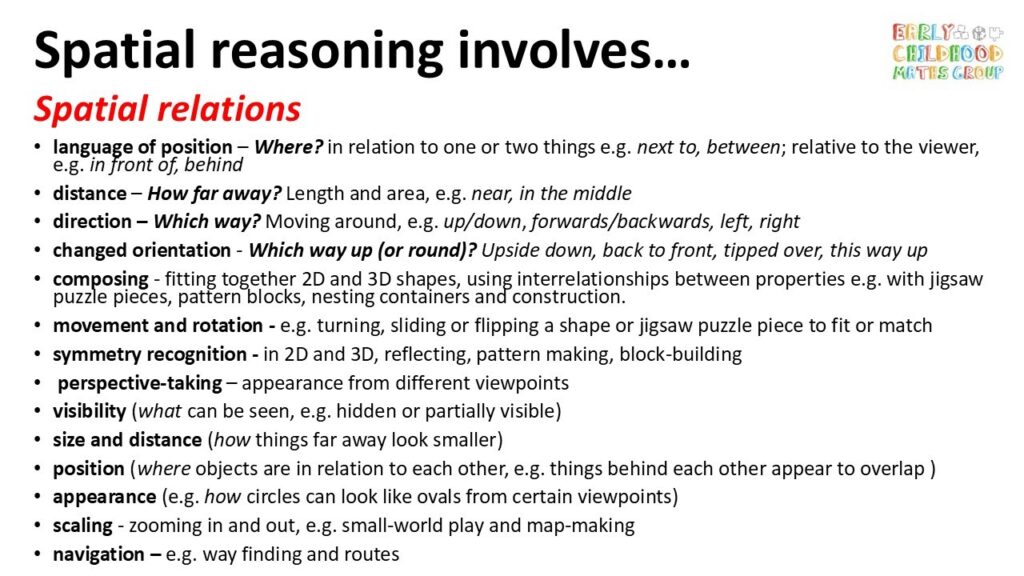
Click the images above to enlarge
These playful investigations are also in line with the EEF’s approach to teaching problem-solving skills for maths, supporting children to reason, predict, and test ideas through active exploration.
For us, here at St Pauls, we have really focused on developing confidence and competence in our own pedagogical subject knowledge.
This has meant we have been able to dig deeper into all aspects of spatial relations – aspects of mathematical ideas and concepts that perhaps we have not considered before or have been unsure about – such as scaling, appearance, visibility, and perspective-taking.
I wonder how many of these concepts we consider – and as a consequence support – when playing alongside children in their Block Play?
We have wanted to ensure that our adult role is one of scaffolding and supporting, extending and challenging children’s understanding of mathematical concepts and ideas.
In Part 2 of Adventures in Block Play, we’ll explore how adults can build on this natural curiosity — using observation, talk and environment design to scaffold mathematical thinking even further.
References
Community Playthings. The important role of the teacher in block play [Video].
https://www.communityplaythings.com/resources/videos/the-important-role-of-the-teacher-in-block-play
Early Childhood Maths Group. Spatial Reasoning Toolkit.
https://earlymaths.org/spatial-reasoning-toolkit/
Erikson Institute Early Math Collaborative. Precursor Concepts.
https://earlymath.erikson.edu/why-early-math-everyday-math/precursor-concepts/
Education Endowment Foundation (EEF). Improving Mathematics in the Early Years and Key Stage 1 [Guidance report].
https://educationendowmentfoundation.org.uk/education-evidence/guidance-reports/early-maths
Education Endowment Foundation (EEF). Early Years Evidence Store – Teaching and Modelling How to Make Comparisons and Connections.
https://educationendowmentfoundation.org.uk/early-years/evidence-store/early-mathematics/teaching-and-modelling-how-to-make-comparisons-and-connections
Join Our Free Webinars and Events for Expert Guidance and Practical Support
To find out more about this evidence-informed approach and see it in real-life practice, you can attend our upcoming early maths events through the Bristol & Beyond Early Years Stronger Practice Hub.