
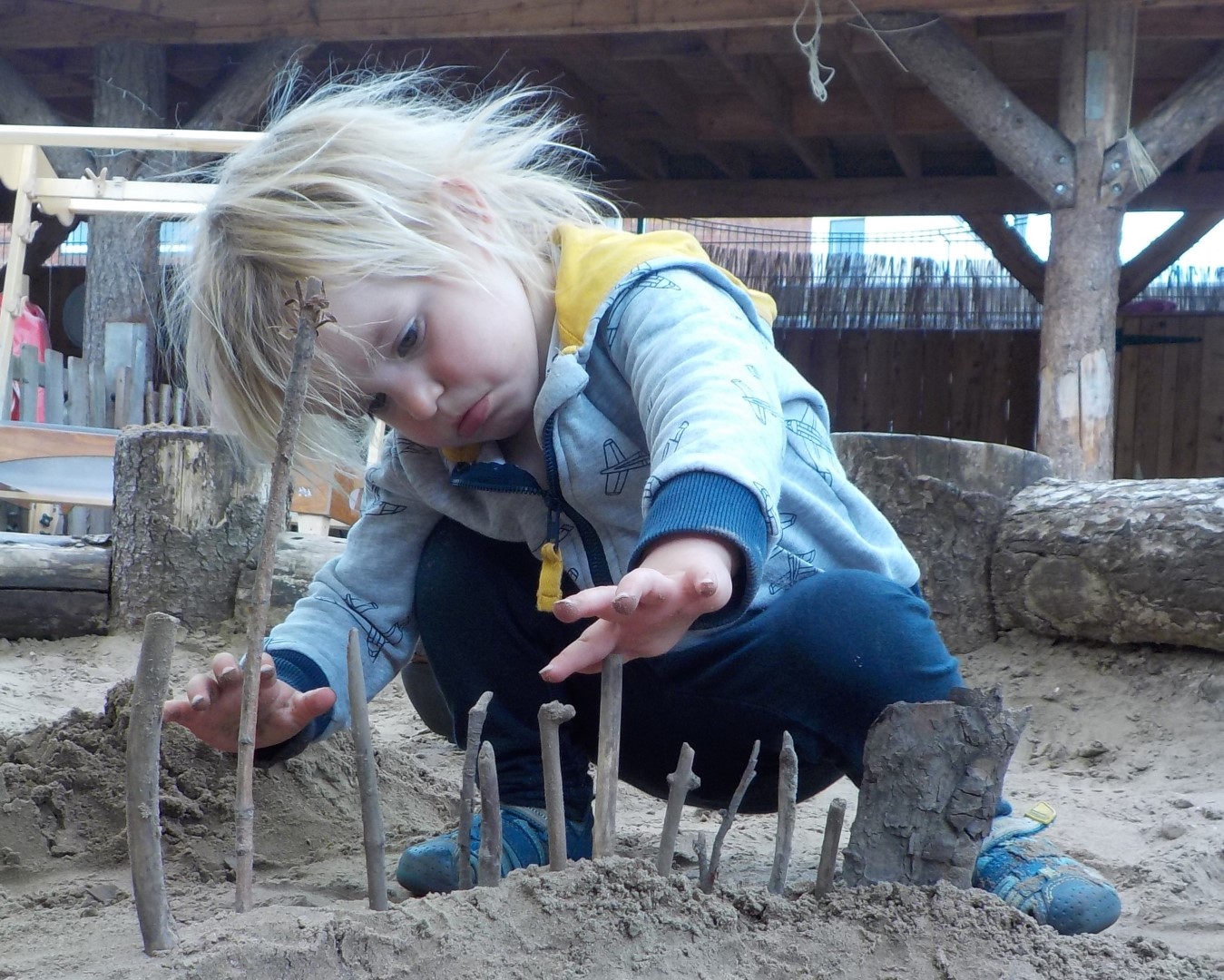

Robin Taylor is Associate Head of St Pauls Nursery School and Children’s Centre and a Specialist Leader in Early Mathematics. He is professional development lead for the NCETM’s Early Years Programme in Somerset and facilitates the Maths Network for Bristol and Beyond Stronger Practice Hub. Robin is obsessed with Block Play and is currently working with Bristol University PHD student Michael Rumbelow in researching block play at St Pauls.
A Phonics for Mathematics? by Robin Taylor
How do children learn to count?
I’ve often wondered…
If I asked myself or another practitioner “How do children learn to read?” what would we say?
I imagine the answer would be all about how important talk is to reading.
Some say “Literacy floats on a sea of talk”!
Or the answer might be about how those ‘classic’ picture books you love to share with children – Dear Zoo, Bear Hunt, Shark in the Park – help children attune to the rhythm and rhyme of the written word.
Your answer might even be about the Core Book approach you use – those texts rich in repetition, vibrant, inviting illustrations and clear storybook structure – and how children return to them again and again to become confident storytellers!
And you might talk about how you help children “tune their ears” to all the sounds around them – musical, environmental, body percussion!
Yes, you might talk about phonological awareness – phonics!
The granular sounds and groups of sounds – those phonemes and digraphs and trigraphs – that children put together and pull apart to blend and segment words – so that they learn to read!
I think whatever the answer would be, it would be a pretty comprehensive answer – a fairly rich answer – wouldn’t it?
But I wonder what you would say if asked: “How do children learn to count?”
I wonder?
Mathematics sometimes gets a “bad rep”, doesn’t it?
We all probably had some maths phobia at school as we tried to interpret, understand, and explain the patterns, sequences, and relationships inherent in algebraic equations.
It’s only really recently that I’ve started to understand how children learn to count or learn a sense of number – what’s called numerosity.
There might not be a phonics of maths, but there are experiences and concepts that are significant in helping children learn to count and ‘read’ numbers.
Foundational Concepts and Skills
“Mathematics is broad, creative, practical and powerful. It is one of the building blocks of life, essential to the natural world and to human development… Babies are mathematical… It is part of their existence and everyday experiences.”
DfE EY Child Development Training, Maths Module 1
What are the firm foundations of mathematics learning?
Just where do we begin on our mathematical journey?
What are the experiences that build on children’s intuitive, natural mathematics and help them become confident, capable and curious mathematicians?
Camilla Gilmore – professor of Mathematical Cognition and Director of the Centre for Early Mathematics Learning at Loughborough University – is investigating children’s mathematical skills before they start school to find out how key mathematical understanding emerges.
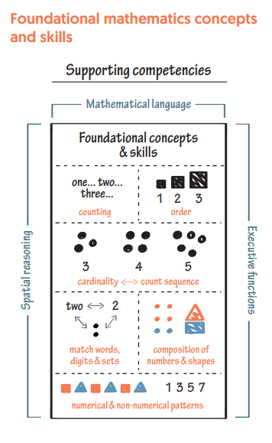
The CEML research describes ‘Foundational Mathematics Concepts and Skills’ in terms of supporting competencies – Spatial Reasoning, Mathematical Language and Executive Functioning.
Camilla and her team say that these competencies ‘hold’ other foundational concepts and skills in place – counting, ordinality, cardinality, and count sequence, and the composition of numbers and shapes.
They’ve illustrated their thinking using this rectangle!
https://ceml.ac.uk/wp-content/uploads/2025/09/CEML-Evidence-Briefing-1-Phonics.pdf
We know about mathematical language – that noticing, talk and thinking are essential to making sense of a mathematical world.
It is THINKING ALOUD when we share experiences, ideas, observations with children – through a “mathematical lens”.
We know that supporting children to manage distractions, become absorbed and develop high levels of involvement in interesting and challenging tasks (that Executive Functioning) is essential to learning.
And we may even hold Spatial Reasoning in pretty high esteem too!
Spatial Reasoning – that drive to see “what fits” – is an essential piece of the jigsaw when thinking about what foundational experiences support mathematical development.
But for Erikson Early Math Collaborative, there are some other things to consider!
Concepts that anchor children’s mathematical thinking!
Anchoring a Child’s Mathematical Thinking
The Erikson Maths Collaborative – a group of American educators and researchers – have found there are fundamental precursors to later mathematical success.
They say,
“… in the first three years of life children engage in a very fundamental way with concepts that anchor a child’s mathematical thinking and are essential for the growth of further mathematics”
They identify 4 key concepts that the very youngest children are developing :
- Attributes – seeing and noticing the properties or qualities that allow us to describe and classify the world around us
- Comparison – is noticing and talking about sameness and difference
- Pattern – involves looking out for the rhythm, sequence and regularity that allows for prediction
- Change – means exploring things that become different – things that “transform”
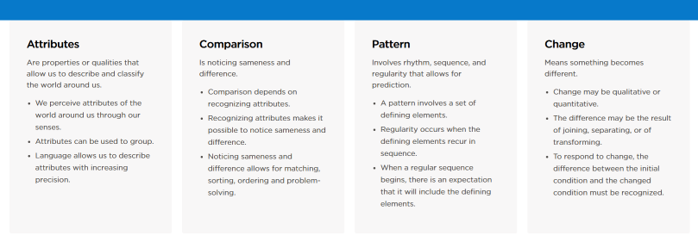
https://www.erikson.edu/early-math-collaborative/precursor-concepts/
So what does this mean for practice and provision?
What “palette of provision” will you need to develop?
What mathematical concepts, tools, materials and tasks will you need to offer children?
Early Maths May Look Like This!
What does your “palette of provision” need in it, if the colour of maths needs to include attributes, comparison, pattern and change?
It will include what Helen Williams (2025) refers to as challenging tasks and interesting mathematical tools, so that children can take the lead in their mathematical learning and practitioners can help create experiences rich in mathematical opportunities.
Missed it live? Watch it back: Rewatch our special Live Panel Webinar, an inspiring evening exploring the joy and creativity of early mathematics with award-winning author Dr Helen J Williams and our expert panel of early years practitioners.
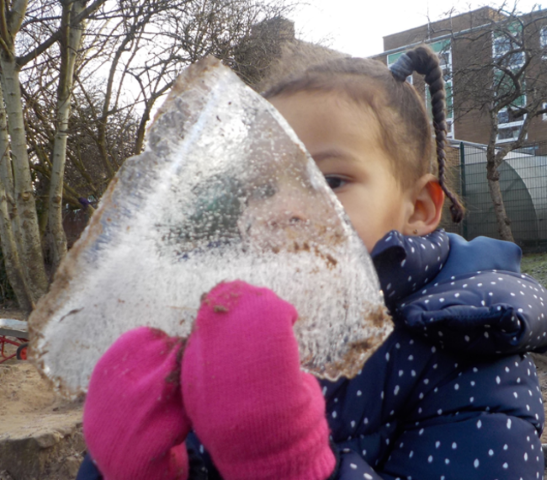
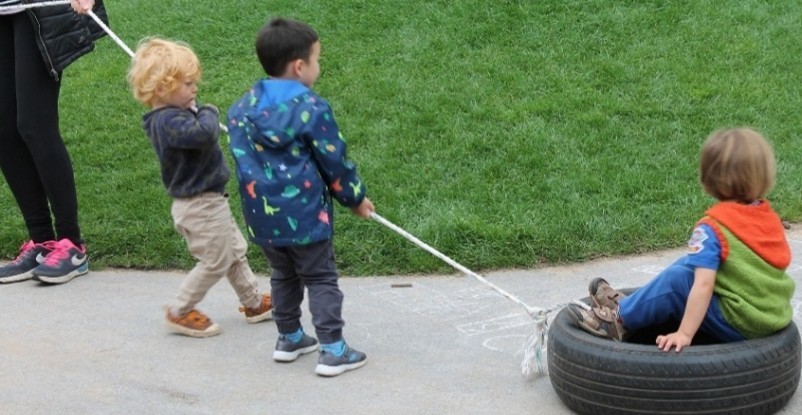
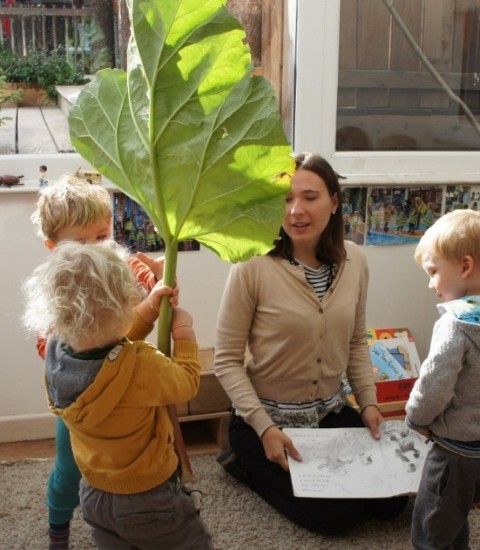
We will be developing provision throughout the day, both inside and outside, building on everyday opportunities using the “stuff of the world” and helping children see and experience it through a mathematical lens.
So, your provision might look a little something like this?
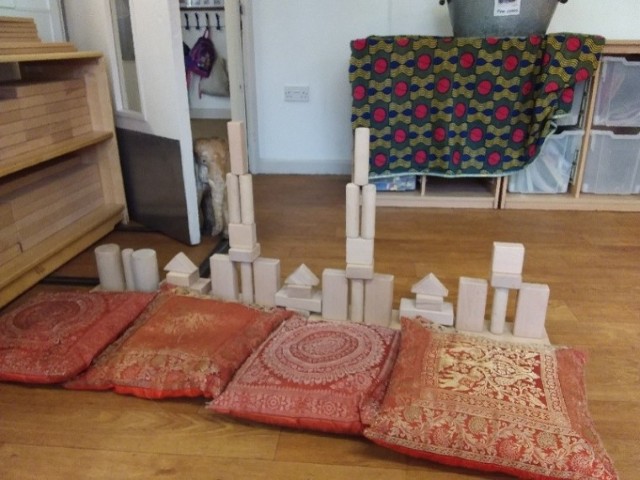
Click the images above to enlarge
Why Knowing and Doing These Firm Foundations Is So So Important Right Now!
So, we know children need the firm foundations of pattern, spatial reasoning, mathematical language and number fluency.
And we know provision and practice need plenty of opportunities for children to wallow in experiences rich in attributes, comparison, pattern and change.
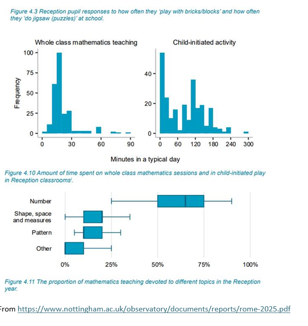
But we can look at Nottingham University’s Review of Education 2025 and consider the emphasis placed in Reception classrooms on number and quickly realise that the learning about number dominates the early years maths experiences.
https://www.nottingham.ac.uk/observatory/documents/reports/rome-2025.pdf
The EEF identify geometry and spatial thinking ( as well as number and operations ) as key areas of early mathematics, describing typical pathways and progressions in the form of “spirals”, with number fluency, problem-solving, comparison and connections, and mathematical language as approaches to teaching mathematical concepts.
https://educationendowmentfoundation.org.uk/early-years/evidence-store/early-mathematics
So, we need to ask ourselves “where do we put the emphasis on our intentional teaching, our routines and continuous provision?”
How do we ensure that children meet the firm foundations of mathematics in their everyday experiences so that they can develop those fundamental precursor concepts that will help them learn to count?
Where are they meeting attributes, comparison, pattern and change – every day?
How do we ensure we are able to articulate and advocate for a provision rich in pattern and spatial reasoning so that children’s number sense is supported by these firm foundations?
There might not be a phonics of maths, but these experiences and concepts are significant in helping children learn to count and ‘read’ numbers.
Join Our Free Webinars and Events for Expert Guidance and Practical Support
To find out more about this evidence-informed approach and see it in real-life practice, you can attend our upcoming early maths events through the Bristol & Beyond Early Years Stronger Practice Hub.